Hey there! As a supplier of PVC Profile Extruders, I often get asked about how to set the speed of the haul - off unit in a PVC Profile Extruder. It's a crucial aspect that can significantly impact the quality and efficiency of your PVC profile production. So, let's dive right into it.
Understanding the Haul - off Unit
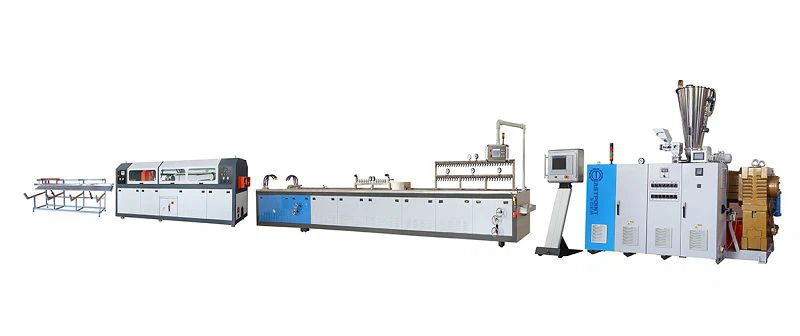
First things first, what's the haul - off unit all about? The haul - off unit in a PVC Profile Extruder is responsible for pulling the extruded PVC profile out of the die at a consistent speed. This speed needs to be carefully adjusted to ensure that the profile has the right dimensions, shape, and surface finish. If the haul - off speed is too fast, the profile may be stretched, leading to reduced wall thickness and potential shape distortion. On the other hand, if the speed is too slow, the profile may accumulate in front of the die, causing uneven cooling and possible defects.
Factors Affecting Haul - off Speed
There are several factors that you need to consider when setting the speed of the haul - off unit.
Extrusion Rate
The extrusion rate of the PVC material from the extruder is a primary factor. The haul - off speed should be in sync with the rate at which the PVC is being pushed out of the die. You can determine the extrusion rate by measuring the amount of PVC extruded over a specific period. For example, if you extrude 10 kilograms of PVC in 10 minutes, the extrusion rate is 1 kilogram per minute. You need to adjust the haul - off speed so that it can handle this amount of material smoothly.


Profile Dimensions
The size and shape of the PVC profile also play a big role. Larger profiles generally require a slower haul - off speed because they take more time to cool and solidify. For instance, a thick - walled PVC pipe will need a lower speed compared to a thin - walled PVC sheet. The cross - sectional area of the profile is a key consideration. You can calculate the cross - sectional area and use it as a reference to set the appropriate speed.
Cooling Capacity
The cooling system of the extruder is another important factor. If the cooling capacity is high, the PVC profile can solidify faster, allowing for a higher haul - off speed. However, if the cooling is insufficient, the profile may still be soft when it reaches the haul - off unit, and a slower speed is necessary to prevent deformation. You can check the temperature of the profile at different points along the cooling path to assess the cooling effectiveness.
Step - by - Step Guide to Setting the Haul - off Speed
Now, let's go through a step - by - step process to set the speed of the haul - off unit.
Step 1: Start with a Baseline
Begin by referring to the manufacturer's recommendations for your specific PVC Profile Extruder. These recommendations are usually based on the machine's capabilities and typical operating conditions. Start with the suggested speed as a baseline.
Step 2: Monitor the Extrusion
Once the extruder is running, closely monitor the extrusion process. Look at the shape and dimensions of the profile as it comes out of the die. If the profile is being stretched or has an irregular shape, the haul - off speed may be too high. If there are signs of material accumulation in front of the die, the speed may be too low.
Step 3: Make Small Adjustments
Based on your observations, make small adjustments to the haul - off speed. Increase or decrease the speed by a small increment, such as 1% or 2%. After each adjustment, wait for a few minutes to allow the system to stabilize and then re - evaluate the profile quality.
Step 4: Check the Cooling
As you adjust the speed, also keep an eye on the cooling process. Make sure that the profile is cooling properly. If you notice that the profile is not cooling fast enough, you may need to slow down the haul - off speed or improve the cooling system.
Step 5: Fine - tune the Speed
Continue making small adjustments and monitoring the profile until you achieve the desired quality. This may take some time and patience, but it's worth it to ensure a high - quality end product.
Importance of Proper Haul - off Speed
Setting the right haul - off speed is not just about getting a good - looking profile. It also has a significant impact on the overall production efficiency. A properly set speed can reduce waste, increase production output, and improve the consistency of the profiles. For example, if the speed is too high, you may end up with a lot of rejected profiles due to shape and dimension issues. On the other hand, if the speed is too low, your production rate will be slow, and you'll be using more energy and resources per unit of production.
Related Products
If you're in the market for a PVC Profile Extruder or related equipment, we offer a range of products that can meet your needs. Check out our PVC Door Frame Extrusion Line, which is designed to produce high - quality PVC door frames with precision. Our PVC Gutter Extruder is perfect for manufacturing PVC gutters that are durable and weather - resistant. And if you're interested in wood - plastic composite products, our Wood Plastic Composite Production Line can help you create innovative and eco - friendly materials.
Conclusion
Setting the speed of the haul - off unit in a PVC Profile Extruder is a critical process that requires careful consideration of multiple factors. By understanding the extrusion rate, profile dimensions, and cooling capacity, and following a step - by - step approach, you can achieve the optimal speed for your production. If you have any questions or need further assistance in setting up your PVC Profile Extruder, don't hesitate to reach out. We're here to help you get the most out of your equipment and produce high - quality PVC profiles. Whether you're a small - scale manufacturer or a large - scale production facility, we can provide the solutions you need. So, if you're interested in purchasing a PVC Profile Extruder or any of our related products, feel free to contact us for a detailed discussion and to start the procurement process.