


Winder
What Is Winder
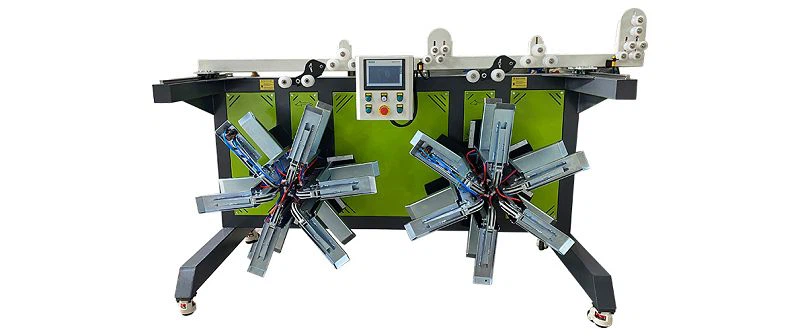
Winder is a machine that is used to wind material such as wire, yarn, rope, and film onto a spool or reel. It is commonly used in textile and wire industries to create spools that can easily be transported and used in the manufacturing process.
Why Choose us
Professional Team
Our team has more than 15 years of experience in plastic extruder design and production. This could translate to more effective problem-solving, faster production times, and better quality output.
Safe Packaging
Export standard packaging is used to ensure that all machines arrive at the customer's factory with a brand new look. Safe packaging minimizes the risks of damage, theft, and other forms of loss during transit.
Advanced Processing Machines
We have advanced CNC machine tools, laser cutting machines, laser welding machines, dynamic balancing machines, etc. to ensure high processing accuracy.
Excellent After-sales Service
Our professional after-sales team will provide high-quality after-sales service, including: formula adjustment, machine installation, machine operation and machine operation skills teaching.


Benefits of Winder
Winder machines can improve the efficiency, quality, and safety of the winding process and provide a cost-effective solution for a range of industries.
Improved product quality
Winder machines can provide consistent winding tension and speed, ensuring that the material is wound evenly. This is particularly important in industries such as textile manufacturing, where a consistent yarn tension is required for optimal product quality.
Reduced waste
Winder machines can also reduce waste by minimizing material loss during the winding process. This is achieved by having precise control over the amount of material wound onto the spool, reducing the risk of overfilling or underfilling.
Cost-effective
Over time, investing in a winder machine can be cost-effective as it reduces the labor cost and increases the efficiency of the winding process. Winders can reduce material waste and increase production output, which lowers overall production costs.
Increased efficiency
Winders machines can wind materials onto spools or reels at a much faster rate than manual winding. This reduces the time needed for winding and allows for increased productivity.
Space-saving
Winders can compactly store large amounts of materials, such as paper or fabric, in a small space, which reduces storage requirements and increases warehouse capacity.
Improved safety
Winding materials manually can be a hazardous task, particularly when dealing with heavy or bulky items. By using a winder machine, the risk of workplace injuries can be reduced.
Common Types of Extruder
Single Screw Extruder: This type of extruder has one screw that rotates in the barrel to melt and mix raw materials.
Hot Melt Extruders: These extruders are used to melt and extrude hot-melt adhesives, films, and coatings.
Twin Screw Extruder: As the name suggests, it has two screws that rotate in the barrel. They provide improved mixing and can handle a wider range of ingredients.
Co-rotating and Counter-rotating Extruders: The co-rotating type has two screws that rotate in the same direction while the counter-rotating one has screws that rotate in opposite directions.
Blown Film Extruders: These extruders are used to manufacture films by blowing air through a ring die to create a bubble of molten plastic.
Food Extruders: These extruders are used in the food industry to produce snack foods, breakfast cereals, and pet foods.
Pharmaceutical Extruders: These extruders are used to manufacture medicinal products, such as pills, capsules, or tablets.
Profile Extruders: These extruders are used to produce extruded products with a specific shape or profile.
Rubber Extruders: These extruders are used to process rubber or rubber-like compounds.
Sheet Extruders: This type of extruder is used to produce sheets of plastic from raw materials.

●It adopts automatically winding, adjusting winding speed and winding method. It has single station for continuous winding.
●It adopts air-operated method. The wheel rib of the winding up wheel adopts cylinder-operated opening and closing.
●It is equipped with a ray creel stand to automatically wind displacement.
●It reaches winding up orderly.
●The machine structure is compact. Its automatic is high.
●Its appearance is beautiful and its operation is convenient.
The following are two major factors, apart from the benefits, which help increase the overall work efficiency of these coil winding machines:
• Multi-spindle: The automatic winding machines feature multi-spindles, which enable the equipment to wind multiple coils at a time.
• Multi-tasking: These automatic machines have the capability to carry out multiple tasks, and processes at the same time. Thus, several industries have discarded their traditional, manually-operated winding machinery, and replaced it with the automatic ones.

Ways of Driving in a Winding Machine
Some of the ways of driving in a winder include:
Surface contact driving
In this process, the grooved drum comes in contact with the package, which is in turn rotated by a motor. Therefore, when the drum is rotated, the package rotates too. As the diameter of the package increases, the speed remains the same.
Direct package driving at a constant speed
Here, the package is placed in a spindle that is rotated by a motor. The package gets motion directly from the motor, and the rate is directly proportional to the diameter.
Direct package driving at variable speed
In this method, the package is placed on the spindle and rotated by a motor. However, the rotational speed of the package increases according to its diameter.

The Winder Automate the Coiling Process
The winder automate the coiling process, making it faster and more efficient compared to manual coiling methods. They are specifically designed to handle the unique characteristics of pe pipes, which are flexible, lightweight, and commonly used for various applications such as water supply, drainage, and irrigation.
The winder are capable of coiling pipes of different lengths and diameters, accommodating a wide range of product specifications. They use precision controls to ensure uniform and tight coiling, preventing twisting or deformation of the pipes.
Furthermore, the winder may incorporate features for packaging the coiled pipes. This can involve automatic wrapping with stretch film or other suitable materials to secure the coils and protect them during transportation or storage.
The winder typically feature user-friendly interfaces and programmable controls, allowing operators to easily set parameters such as coil diameter, wrapping tension, and packaging options. This flexibility enables customization based on specific product requirements.
Reasons Why Winders Is so Popular
These coil winding machines have a better versatility than their manual counterparts. Besides, they are easy to install and operate, and have a lower failure rate.
Unlike manual winding machines, they have the capability to deliver stable operation.
They help reduce the labor requirement for operation. This helps reduce the labor, as well as production costs considerably.
These automatic winding machines can be used to wind various types of wires, such as ac, dc, data lines, etc.
All these beneficial features increase the efficiency. However, there are other two major factors that add to the efficiency. These two factors are explained in the following section of the post.


Precautions for Use Winder
Load the pipe
Take the end of the pipe and feed it into the Winder machine. Make sure that it passes through the center of the Winder machine so that it can be wound properly. If necessary, use a guide tube to help the pipe stay straight as it is wound.
Watch the progress
Keep an eye on the Winder machine as it winds the pipe. Make sure that the coiling is even and that the pipe is not twisting or bunching up in the Winder machine. Adjust the tension or speed settings as needed to achieve the desired outcome.
Cut the coil
When the coil is complete, use a cutting tool such as a saw or an electric cutter to cut the pipe cleanly at the end of the coil.
Set up the machine
First, make sure that the pipe winding Winder machine (or PE tube coiler) is set up correctly. Adjust the tension and speed settings according to the size and type of pipe you are coiling.
Start the machine
Turn on the power to the pipe winding Winder machine and activate the winding mechanism. The Winder machine will begin to turn, winding the pipe neatly and tightly into a coil.
Store the coil
Carefully remove the coil from the Winder machine and store it on a rack or in a bin. Make sure that the coil is properly labeled and organized so that it can be easily retrieved when needed.
Clean up
Once you have finished coiling all of the pipe, turn off the Winder machine and clean up any debris or leftover material. Store the Winder machine in a safe and secure location until it is needed again.
The Importance of Winder
This not only saves time and money on labor but ensures that your coils of pipe are all uniform in size.
Today, industry leading plastic pipe production lines are entirely synced via the internet allowing extrusion engineers to control all aspects of production from a single hmi. While this is makes the engineers job easier most production lines will require an additional operator at the end of the line to switch out and strap finished coils of pipe from the Winder.
What many pipe manufacturers don’t know is that this labor intensive process can be almost entirely automated with an automatic pipe Winder. Winder is capable of syncing up with a production line and automatically coiling fresh coils of pipe. Not only does Winders coil pipe to your desired length, but it will automatically cut, switch reels, strap and eject coils that are ready for sale.
This not only saves time and money on labor but ensures that your coils of pipe are all uniform in size. A fully automatic coiler also has great applications in the world of drip irrigation as some are capable of counting drippers so that each coil of drip irrigation pipe you produce has the exact same number of drippers per coil. These types of coilers are generally for a specific type of pe pipe with some specializing in round drip irrigation / pe pipe and others for flat drip irrigation pipe.
An automatic Winder should be paired with a pipe acumulator to make sure that your pipe does not get tangled during the time it takes for the automatic switching of reels. Additionally some manufacturers opt to include a shrink wrapping machine that spins and wraps coils, so that they are not damaged during shipping.
With a speed of up to 130 meters per minute and a pipe size range of 12 – 25 mm an automatic Winder is the perfect addition to any manufacturer looking to automate a normally labor intensive part of their production line.
When Choosing a Winder, You Should Consider
When picking out a winder, you can take into consideration the physical design of the coil, production rate, etc. However, the first two things to consider are the wire diameter and coil dimension.
Weight of coil
The coil dimensions along with the total weight of the coil need to be considered when choosing a winder. The overall functioning of the machine will change if the coil weighs more or less. This will have a direct impact on your deliverables. Additionally, a machine that is unable to handle the requisite weight of the coil will hamper the overall production process. Hence, the weight of the coil needs to be taken into consideration when deciding on the specifics of the machinery.
Coil dimension
A winder can easily accommodate a wire with small dimensions. Wires with large dimensions need to be used with machines designed specifically for that purpose. Hence, the largest coil dimension you require should be taken into consideration when purchasing a winder. The dimensions of round/ square/ rectangular/ trapezoidal coils can be calculated taking into consideration the length of the coil, as well as the diameter (of round coils) and diagonal length (of square/ round/ trapezoidal coils).
Coil winding method
The methods employed to wind the coils need to be taken into consideration when choosing the right winder. Will the coil be wound at slow speeds with high torque, or high speeds with low torque? Along with this, the rate of production needs to be considered to ensure that the right combination of speed and torque matches with the weight and dimensions of the coil.
Wire diameter
Wires with varying diameters will be wound using the winder. The minimum and maximum diameter of wires that will be wound on the machine should be taken into consideration. This will allow you to narrow down the choices considerably.
Do You Know Winder Machine
Winder is the name of a device at the end of the polyethylene pipe production line. All polyethylene pipes should coils by this device that this work cannot do by hand or other tool.
Polyethylene pipes up to 110 mm in size and up to 16 bar can coil by winder. The length of the polyethylene skein is calculated in relation to its size and pressure, and larger pipes and close to 110 mm, up to 100 meters, and polyethylene pipes of smaller size up to 400 meters and even more. Winder is one of the required equipment for small-size polyethylene pipes, these pipes are commonly used for irrigation and agricultural applications, and production of skein polyethylene pipe has many advantages, and increase the speed of installation and operation of the polyethylene pipeline to a considerable degree, and, in order for a regular and appropriate skein HDPE pipe to be produced and supplied, standard winder equipment is required.
Speed winder should be adjustable, and should be coordinate with the line of production and other equipment, and its arms are easily controllable and pneumatic, and is equipped to step motor, PLC control and HMI touchscreen and ball bearings rail, and work with high precision and low depreciation, and can produce regular coils.
PE pipe winder is a machine for winding extruded plastic pipes. Commonly used in the production of PVC, PE, PP pipes. The PE pipe winder is an important part of the pipe production line, which ensures that the pipe is wound neatly and tightly, and is convenient for transportation and storage.
PE pipe winder can be manual or automatic. Manual winders require an operator to start and stop the winding process, while automatic winders use sensors to detect pipe diameter and adjust winding speed accordingly.
PE pipe winder plays a vital role in the production of plastic pipes. Make sure the tubing is neatly and tightly wound for easy transport and storage.
Specification of PE pipe winder
|
No. |
Model |
Winding size |
Winding speed |
Winding length |
Coil ID |
Working position |
|
1 |
SJ-32 |
16-32 |
70-80m/m |
500m |
Φ1400-Φ2400mm |
2 Position |
|
2 |
SJ-63 |
20-63 |
30m/min |
500m |
Φ1400-Φ2400mm |
2 Position |
|
3 |
Sj-110 |
20-50 |
30m/min |
500mm |
Φ1400-Φ2400mm |
2 Position |
|
63-110 |
10m/min |
200mm |
Φ500-Φ1200mm |
2 Position |
Company Profile
We are a professional plastic extruder manufacturer in China. Based on the principle of being honest with customers and being responsible for product quality, we are committed to producing high-quality equipment with low energy consumption, high output, and stable operation.
We have 4 local office in South Asia, Middle east, and Africa and Europe, by providing high quality plastic extruders and good after sales service, our extruder machines are highly recognized by our customers.

Ultimate Faq Guide to Extruder