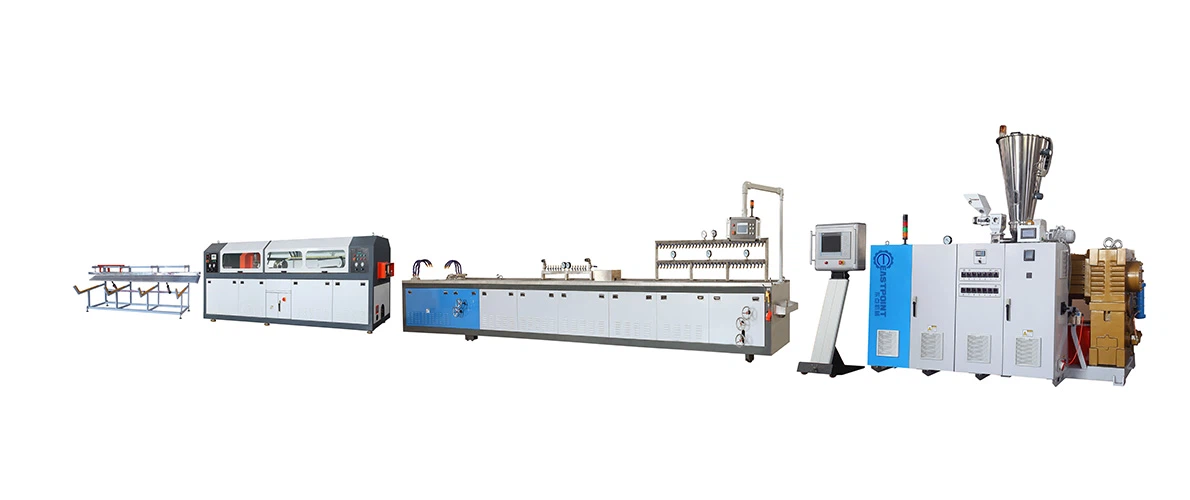
I. Core Extrusion Stability Testing
Sampling and Weighing Method: Take 5-6 extruded products at fixed time intervals. A stable state is indicated by a weight fluctuation within 3%-5%.
Melt Pressure Monitoring: Melt pressure fluctuation at the die head should be controlled within ±1.0 MPa. Exceeding this indicates an imbalance in extrusion pressure.
Extrusion Volume Deviation Verification: For PE-RT pipe production lines, the extrusion volume deviation should be ≤±1.5%; for wall panel profile production lines, the deviation should be ≤±2%.
II. Finished Product Quality Verification
Wall Thickness Accuracy: For high-end production lines equipped with melt pumps, the pipe wall thickness deviation should be stably controlled within ±1%; for ordinary production lines, the deviation should not exceed ±5%.
Appearance Defect Inspection: The pipe surface should be free of continuous roughness, grooves, silver streaks, bubbles, etc., and circumferential cooling should be uniform without obvious ellipticity.
Continuous Operation Performance: Continuous 8-12 hours of full-load production with output fluctuations controlled within ±3%, and no sudden unplanned shutdowns.
III. Equipment Operation Status Verification
Temperature Control: Temperature fluctuations in each heating zone ≤ ±5℃, temperature control accuracy meets standards, and there are no frequent start/stop cycles of heating coils or over-temperature alarms.
Transmission and Vibration: Effective vibration values at the gearbox and screw thrust bearing ≤ 4.5mm/s, with no abnormal noises, and no significant fluctuations in main unit current.
Auxiliary System Stability: Vacuum setting chamber vacuum level is stable at -0.03~-0.06MPa, with fluctuations not exceeding ±0.005MPa, and cooling water pressure shows no frequent fluctuations.