


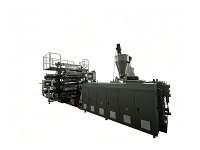


PVC Cable Conduit Extrusion Line
This rigid PVC cable conduit extrusion line is designed for continuous, high-efficiency manufacturing of electrical protection conduits, flexible/rigid UPVC conduits, and corrugated ducting. Engineered specifically for rigid PVC formulations with high calcium carbonate (CaCO3) filler loadings (ranging from 8 to 50 PHR), the system delivers precise wall thickness control, high melt homogeneity, and strict dimensional stability.
Available in single-outlet, double-outlet (twin-pipe), and four-outlet configurations, the line processes pipe diameters from 16mm to 63mm with throughput capacities reaching up to 450 kg/h. The processing line ensures full compliance with international electrical conduit standards, including UL 651 (Schedule 40/80 rigid PVC conduit) and BS EN 61386 (conduit systems for cable management).
[IMAGE: Full Production Line Overview] Alt text: Continuous rigid PVC cable conduit extrusion line with twin-pipe die and dual downstream unit in operation.
Production Process
The automated extrusion line operates on a synchronized closed-loop cycle from raw powder intake to final pipe stacking.
Main Components
Conical Twin-Screw Extruder (SJZ Series)
• Screw & Barrel Geometry: Nitrided alloy steel (38CrMoAlA) with plasma bimetallic alloy coating (thickness 2.0–3.0 mm, hardness HV950–1100) for high resistance against abrasive CaCO3 fillers.
• Temperature Control: 4 to 6 cast-aluminum heating zones equipped with low-noise air-cooling fans.
• Degassing System: High-vacuum vent zone equipped with a liquid-ring vacuum pump to remove volatiles, moisture, and residual monomer gases from the PVC melt prior to entering the die.
• Drive System: AC frequency inverter motor coupled with a heavy-duty high-torque vertical distribution gearbox featuring integrated thrust bearings (NSK / SKF).
Multi-Cavity Extrusion Die Head
• Material: 40Cr forged alloy steel, internal flow channels hard-chrome plated and mirror-polished (Ra < 0.05 µm).
• Flow Design: Spiral or basket-type melt distributor optimized for symmetrical pressure distribution across 1, 2, or 4 outlets. Prevents melt weld lines and ensures uniform wall thickness across all cavities.
• Heating: Stainless steel heating rings with individual PID thermal zone controllers.
Vacuum Calibration & Cooling Tanks
• Material: Full SUS304 stainless steel construction for tank body, covers, internal piping, and spray nozzles.
• Calibration: High-precision bronze or stainless steel sizing sleeves with water-ring vacuum chamber control (-0.03 MPa to -0.09 MPa).
• Cooling System: High-efficiency brass mist spray nozzles arranged multi-directionally along the tank length; manual 3D alignment system (forward/backward, up/down, left/right) on linear guide rails.
Servo Caterpillar Haul-Off Unit
• Drive: Synchronized multi-caterpillar haul-off driven by individual Siemens or Yaskawa servo motors, interfaced via CANbus to the main line controller.
• Clamping: Pneumatic sync-clamping mechanism with high-friction, wear-resistant rubber pads customized for 16–63mm pipe profiles to eliminate pipe deformation or slippage.
Planetary / Chipless Cutting Unit
• Cutting Action: Rotary knife fly-cutter (chipless) or high-speed planetary circular saw.
• Operation: Synchronized pneumatically with haul-off speed via optical encoder feedback, producing smooth, 90-degree square-cut pipe ends without burrs, dust, or micro-cracks.
Online Pipe Belling / Socketing Machine (Optional)
• Type: Automated inline belling unit for producing solvent cement sockets (smooth wall) or elastomeric rubber seal ring sockets.
• Heating: Infrared ceramic heating oven with internal/external rotation for uniform pipe end heating.
Key Advantages
Low Operating Melt Temperatures: The optimized screw shear profile melts PVC dry-blends at lowered temperatures (175°C - 190°C), preventing thermal degradation of PVC chains and reducing stabilizer consumption.
High Filler Loading Capability: Specialized screw geometry permits stable plasticization with up to 50 PHR CaCO3, lowering raw material formula costs while retaining pipe impact resistance.
High Output per Footprint: Multi-cavity dies (2-outlet and 4-outlet) double or quadruple throughput capacity on a single extruder base without increasing factory floor space requirements proportionately.
Energy Efficiency: Direct-coupled helical gearboxes and IE3/IE4 premium efficiency motors lower overall electrical power consumption per kilogram of processed material (0.28 - 0.35 kWh/kg).
Closed-Loop Line Synchronization: Centralized PLC integration synchronizes extruder screw speed, feeder rate, haul-off velocity, and cut length automatically during speed ramp-up or ramp-down.
Technical Specifications
|
Parameter |
Model GF-32-4 |
Model GF63-2 |
Model GF110-2 |
Model GF160 |
|
Number of Outlets (Cavities) |
4 Outlets |
2 Outlets |
2 Outlets |
1 Outlet |
|
Pipe Diameter Range (OD) |
Ø16 mm - Ø32 mm |
Ø16 mm - Ø63 mm |
Ø50 mm - Ø110 mm |
Ø63 mm - Ø160 mm |
|
Extruder Model |
SJZ-65/132 |
SJZ-65/132 |
SJZ-80/156 |
SJZ-65/132 |
|
Screw Type |
Conical Twin Screw |
Conical Twin Screw |
Conical Twin Screw |
Conical Twin Screw |
|
Max. Extrusion Throughput |
200 - 250 kg/h |
250 - 300 kg/h |
350 - 450 kg/h |
200 - 300 kg/h |
|
Main Extruder Motor Power |
37 kW |
37 kW |
55 kW |
37 kW |
|
Total Line Power Installed |
101 kW |
105 kW |
140 kW |
115 kW |
|
Vacuum Tank Length |
6000 mm x 1 |
6000 mm x 1 |
6000 mm x 2 |
6000 mm x 2 |
|
Cooling Method |
Vacuum Spray |
Vacuum Spray |
Vacuum Spray |
Vacuum Spray |
|
Cutting Method |
Chipless Knife |
Chipless Knife |
Planetary Saw / Knife |
Planetary Saw |
|
Control System |
Siemens PLC / HMI |
Siemens PLC / HMI |
Siemens PLC / HMI |
Siemens PLC / HMI |
|
Total Line Dimensions (LxWxH) |
18m x 2.8m x 2.5m |
23m x 3.0m x 2.5m |
27m x 3.2m x 2.6m |
26.5m x 2.8m x 2.6m |
Typical Applications
Electrical & Power Cable Protection Conduits: Rigid UPVC smooth-wall pipes installed in commercial, residential, and industrial electrical installations (UL 651 Schedule 40 & 80).
Underground Telecom & Data Fiber Ducts: Direct-buried multi-channel sub-ducts for telecom and fiber optic wire management.
Low-Smoke Halogen-Free (LSHF) / Flame-Retardant Conduits: Specialty conduit formulations for public infrastructure, transit systems, and high-occupancy structures.
Flexible Corrugated PVC Wiring Hose: Industrial machine tool internal wiring, automotive wire harnesses, and building cable drops (produced with an optional corrugated pipe machine module).
How to Select the Right Machine
Selecting the optimal extrusion line configuration depends on target pipe sizing, output requirements, raw material formulation, and factory floor space.
Selection Criteria Matrix
For High-Volume Small Diameters (16mm to 32mm):
• Recommended System: GF-32-4 (Four-Outlet Line).
• Rationale: Maximize total production output per kilowatt-hour of energy consumed. Operates 4 pipe strands simultaneously from one SJZ-65/132 extruder.
For Versatile Diameter Range (16mm to 63mm):
• Recommended System: GF63-2 (Double-Outlet Line).
• Rationale: Provides high flexibility for changeovers between standard residential conduit sizes (1/2", 3/4", 1", 1-1/2", 2") while maintaining output up to 300 kg/h.
For Heavy Filler Formulations (>30 PHR CaCO3):
• Recommended System: SJZ-65/132 or SJZ-80/156 with Bimetallic Screw/Barrel treatment.
• Rationale: High-filler loading accelerates mechanical wear on screw flights. Deep nitrided or bimetallic layers prevent rapid loss of screw compression and output drop-offs.
Quality Control & Factory Testing
Every extrusion line undergoes systematically logged quality verification before sign-off and dispatch.
Factory Acceptance Testing (FAT) Protocols
• 24-Hour Mechanical Dry Run: The extruder and downstream units operate continuously for 24 hours without raw material to verify gearbox temperature stability, bearing vibration levels, and electrical drive thermal profiles.
• Vacuum & Hydraulic Integrity Test: Vacuum cooling tanks undergo pressure retention testing to confirm air leaks do not exceed 0.002 MPa/hr under full operating vacuum (-0.08 MPa).
• Raw Material Extrusion Trial: Full-load running using customer-specified PVC formulation for 4 to 8 continuous hours. Key melt metrics (melt pressure, melt temperature, drive load %) are recorded.
Extruded Pipe Inspection:
• Wall Thickness Uniformity: Ultrasonic wall thickness gauge measurement around 8 points of the pipe circumference. Variance must remain within +/- 0.15 mm.
• Ovality & Diameter: Caliper checking of pipe roundness.
• Flattening & Impact Resistance: Sample pipes undergo cold-temperature drop weight impact testing and 90-degree flattening tests according to IEC 61386 specifications.
Why Work with Us
In-House Mechanical Machining: Extruder frames, gearboxes, vacuum tanks, and dies are machined in-house on modern CNC machining centers to ensure tight assembly tolerances and structural longevity.
Standardized Electrical Architecture: Built with off-the-shelf industrial components from international suppliers (Siemens PLCs, Schneider contactors, ABB inverters, Omron temperature modules), ensuring local replacement availability in North America and Europe.
Complete Process Engineering: Beyond equipment assembly, we deliver customized screw geometry designs based on exact customer PVC dry-blend formulas and filler percentages.
Pre-Shipment Trial Verification: Customers receive complete video documentation, thermal imaging logs, and dimensional inspection reports from actual material running tests prior to shipment approval.
Technical Commissioning Support: Field service engineers perform onsite installation, line balancing, operator training, and raw material formulation tuning worldwide.
Technical FAQ
Hot Tags: pvc cable conduit extrusion line, China pvc cable conduit extrusion line manufacturers, suppliers, factory, PE Pipe Extrusion Line, PE Pipe Producing Line, PE Pipe Production Line, Pipe Extrusion Line, PP Pipe Extrusion Line, PVC Pipe Producing Line
You Might Also Like


Send Inquiry