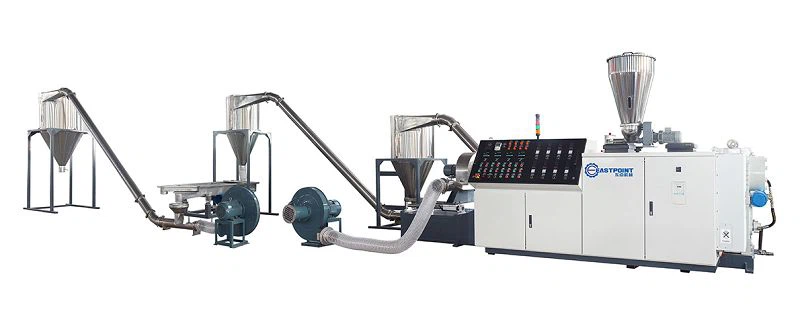
Hey there! If you're in the plastics industry, you might've heard a lot about PVC Pelletizing Lines. As a supplier of these awesome machines, I'm super excited to break down the key technologies involved in a PVC Pelletizing Line.


Let's start with the basics. A PVC Pelletizing Line is a crucial piece of equipment that turns PVC raw materials into uniform pellets. These pellets are then used in all sorts of products, from pipes and cables to window profiles and flooring.
Extrusion Technology
The heart of any PVC Pelletizing Line is the extruder. This is where the magic happens. The extruder heats and melts the PVC raw material, then pushes it through a die to form the desired shape. There are two main types of extruders used in PVC pelletizing: single - screw extruders and twin - screw extruders.
Single - screw extruders are simpler and more cost - effective. They're great for processing PVC materials with a low to medium viscosity. They work by using a single rotating screw to convey, compress, and melt the material. But they have their limitations. They might not be as efficient in dispersing additives or handling complex PVC formulations.
On the other hand, twin - screw extruders are the heavyweights of the extrusion world. They have two intermeshing screws that rotate in the same or opposite directions. This design provides better mixing, higher throughput, and more precise control over the extrusion process. Twin - screw extruders are ideal for processing PVC with high - performance additives, such as heat stabilizers, lubricants, and colorants. They can handle a wider range of PVC formulations and produce higher - quality pellets.
Feeding Technology
Proper feeding is essential for a smooth and efficient PVC Pelletizing Line. There are different feeding systems available, and each has its own advantages.
Gravimetric feeding systems are very accurate. They measure the weight of the raw materials being fed into the extruder. This allows for precise control of the material flow rate, ensuring consistent pellet quality. Gravimetric feeders are often used when dealing with expensive additives or when strict quality control is required.
Volumetric feeding systems, on the other hand, are simpler and more affordable. They measure the volume of the raw materials being fed. While they might not be as accurate as gravimetric feeders, they're still a popular choice for many PVC pelletizing operations, especially for large - scale production where a certain degree of variability can be tolerated.
Cutting Technology
Once the PVC material is extruded, it needs to be cut into pellets. There are two main cutting methods: strand cutting and underwater cutting.
Strand cutting is a traditional method. The extruded strands are cooled in a water bath and then pulled through a pelletizer, where a rotating blade cuts them into pellets. This method is relatively simple and cost - effective. It's suitable for producing pellets of various sizes and shapes. However, it might require more space for the cooling process and can sometimes result in uneven pellet lengths.
Underwater cutting is a more advanced method. In this process, the extruded material is cut into pellets immediately as it exits the die, underwater. The water helps to cool and solidify the pellets quickly. Underwater cutting produces very uniform pellets with a smooth surface finish. It's also a cleaner process, as there's no need for a separate cooling bath. However, it requires more complex equipment and a higher level of technical expertise to operate.
Cooling Technology
Cooling is a critical step in the PVC pelletizing process. Proper cooling ensures that the pellets solidify correctly and have the right physical properties. There are several cooling methods used in PVC Pelletizing Lines.
Air cooling is a simple and cost - effective method. Pellets are conveyed through a stream of air, which removes the heat from them. This method is suitable for small - scale production or for pellets that don't require rapid cooling.
Water cooling is more common in large - scale PVC pelletizing operations. As mentioned earlier, in strand cutting, the extruded strands are cooled in a water bath. In underwater cutting, the water itself acts as the cooling medium. Water has a high heat - transfer capacity, which allows for rapid cooling of the pellets. However, water cooling requires proper water treatment to prevent contamination of the pellets.
Additive Dispersion Technology
To add specific properties to the PVC pellets, additives such as heat stabilizers, lubricants, and colorants are often used. Ensuring proper dispersion of these additives is crucial for the quality of the final pellets.
High - shear mixing technology is commonly used for additive dispersion. Twin - screw extruders are excellent at providing high - shear mixing. The intermeshing screws create a high - intensity mixing environment that breaks up the additive particles and distributes them evenly throughout the PVC matrix.
Another approach is the use of pre - mixing systems. Additives can be pre - mixed with a small amount of PVC resin before being fed into the extruder. This helps to ensure a more uniform distribution of the additives in the final pellets.
Quality Control Technology
No PVC Pelletizing Line is complete without proper quality control measures. In - line sensors are used to monitor various parameters during the pelletizing process, such as temperature, pressure, and pellet size. These sensors provide real - time data that can be used to adjust the process parameters and ensure consistent pellet quality.
Offline testing is also important. Samples of the produced pellets are taken regularly and tested for physical properties such as density, melt flow index, and color. This helps to detect any quality issues early on and take corrective actions.
Now, if you're running a plastics manufacturing business and you're looking to upgrade your production line or invest in a new PVC Pelletizing Line, we've got you covered. We also offer PE Pelletizing Line and Color Masterbatch Extrusion Line, which are equally important in the plastics industry.
We're here to help you choose the right technology for your specific needs. Whether you're a small - scale operation or a large - scale manufacturer, we can provide a customized solution that fits your budget and production requirements. If you're interested in learning more about our products or want to discuss a potential purchase, don't hesitate to reach out. We're more than happy to have a chat and help you make the best decision for your business.