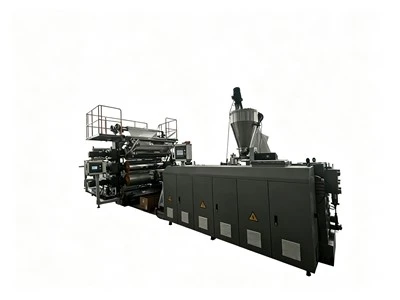
If you've ever walked past a plastics manufacturing facility, you've probably seen the final step of a pellet extrusion line: tiny, uniform beads of plastic cooling on a conveyor, ready to be packaged for distribution. What you might not notice, though, is the cooling system working behind the scenes to turn molten plastic into those consistent pellets-without it, the process would fall apart, leading to inconsistent product quality, downtime, and even safety risks. As a supplier of pellet extrusion lines, I've spent years refining cooling systems to match the unique needs of different materials, and today I'm breaking down exactly what makes these systems work, why they matter, and how they adapt to lines like our Color Masterbatch Extrusion Line, PE Pelletizing Line, and PVC Pelletizing Line.
First, let's start with the basics: why cooling is non-negotiable for pellet extrusion. When plastic resin is fed into an extruder, it's heated to temperatures between 180°C and 300°C, depending on the material, to melt and mix it into a homogenous melt. Once this melt exits the die head (the final part of the extruder that shapes it into strands), it's still hot enough to deform, stick together, or warp if not cooled quickly. The cooling system's core job is to solidify those strands into rigid pellets before they're cut, but it does much more than that: it stabilizes the pellet's molecular structure, prevents post-production shrinkage, and ensures every bead has a consistent size and shape. For applications like color masterbatch, where uniform pigment dispersion and pellet integrity are critical for end-product performance, even a small cooling inconsistency can lead to streaked plastics or batches that fail quality tests.
Now, not all cooling systems are the same-their design depends entirely on the pelletizing stage, the material being processed, and the line's production capacity. There are two primary types of cooling setups used in modern pellet extrusion lines, and I've integrated both into our offerings to cover every client's needs: strand cooling (the most common for medium to high-volume lines) and underwater pellet cooling (ideal for flexible, high-throughput materials). Let's dive into both, and how they apply to our specific lines.
Strand cooling is the traditional workhorse for pellet extrusion lines, especially for materials like PVC. Here's how it works: after the molten strand exits the die head, it first passes through a water bath that's temperature-controlled to between 20°C and 60°C (adjustable based on the material). The bath is long enough-usually 5 to 15 meters, depending on production speed-to fully solidify the strand before it reaches the pelletizer. A series of pullers then feed the solid strands into a rotating cutter head, which chops them into uniform pellets. For our PVC Pelletizing Line, for example, we've optimized the strand cooling bath to include gentle agitation to prevent the soft PVC strands from sticking together mid-cooling, a common issue with rigid PVC that would ruin pellet uniformity. We also add inline water filtration here to remove any stray plastic debris, which would otherwise damage the cutter blades and cause downtime.
But strand cooling isn't one-size-fits-all. For color masterbatch, which often uses smaller, more delicate strands to ensure precise pigment distribution, we've adjusted the strand cooling system to use a narrower, more uniform water flow. That's why our Color Masterbatch Extrusion Line includes a precision temperature regulator for the cooling bath-fluctuations of even 5°C can cause a color masterbatch strand to cool unevenly, leading to inconsistent pigment loading in the final pellets. That might sound like a small detail, but it's the difference between a batch of masterbatch that works for automotive interior plastics and one that gets rejected by quality control.
For higher-volume lines, especially PE Pelletizing Line used for packaging materials or agricultural films, underwater pellet cooling is the go-to. This system skips the water bath entirely, instead cutting the molten strand (or directly cutting the melt at the die head) inside a chamber filled with circulating water. The water immediately cools the pellets as they're cut, solidifying them in milliseconds-critical for PE, which has a lower melting point and is more prone to thermal degradation if cooled too slowly. Underwater cooling also eliminates the need for a long strand conveyor, reducing the line's footprint by up to 30% compared to strand cooling, a huge benefit for facilities with limited floor space. For PE lines, we adjust the water flow rate to match the extrusion speed: if the line is running at 500 kg per hour, the cooling water must circulate at 10 cubic meters per hour to keep pellet temperature at a consistent 25°C, preventing PE pellets from sticking together after they're dried.
A common misconception I hear from new clients is that cooling systems are just "pipes and water"-but they're actually precision-engineered to balance speed, temperature, and material compatibility. Let's break down the key components that make a cooling system effective, regardless of type.
First, temperature control units (TCUs) are the backbone. These are not your basic aquarium heaters: TCUs for pellet extrusion lines can maintain water temperature within ±1°C, even as production speeds change. For materials like PVC, which is sensitive to thermal shock, we use a dual-stage TCU that gradually lowers the water temperature as strands move through the bath, preventing the PVC from cracking during cooling. For PE, which benefits from faster cooling to lock in molecular structure, our TCUs can ramp up water flow in seconds to match spikes in extrusion output.
Second, water filtration and treatment systems. If the cooling water has sediment, minerals, or bacteria, it can leave deposits on the pellets, discolor them, or cause blockages in the line. That's why all our lines include a multi-stage filtration system: first a 100-micron filter to catch large debris, then a 20-micron filter for smaller particles, and finally UV sterilization to prevent bacterial growth. For color masterbatch lines, we add a carbon filter to remove any residual impurities that could alter the pigment's brightness-an essential feature for clients manufacturing masterbatch for cosmetic packaging or toy plastics, where color consistency is non-negotiable.
Third, drying systems, which are often paired with cooling but not always considered part of the cooling process. After cooling, pellets are wet and need to be dried to <0.1% moisture content before packaging, because even a tiny amount of water will cause bubbles or degradation during the final plastic molding stage. For strand cooling lines, we use a centrifugal dryer that spins pellets at 1,200 RPM to remove surface water. For underwater cooling lines, we add a hot air dryer set to 60°C, which gently evaporates moisture without warping the flexible PE pellets. I've seen too many lines fail because they cut corners on drying-pellets come out with water marks, break easily, and waste hundreds of kilograms of material before the client even gets a chance to test them.
Now, let's talk about common challenges our clients face with cooling systems, and how we solve them. One frequent issue is "strand breakage" during strand cooling-when a molten strand cools too fast, it becomes brittle and snaps before it reaches the pelletizer, halting production. For clients running our Color Masterbatch Extrusion Line, this is especially problematic because color masterbatch strands are thinner, making them more prone to breakage. Our solution: we add a secondary, low-temperature water spray before the main bath to pre-cool the strands gradually, then adjust the puller speed to match the cooling rate. We also equip all our lines with a automatic strand detection system that pauses the pullers if a break is detected, preventing damage to the pelletizer.
Another challenge is energy efficiency. Many older cooling systems waste a lot of water and energy by over-circulating water or maintaining temperatures higher than necessary. That's why all our modern lines, including our PE Pelletizing Line, use closed-loop cooling systems that recycle 95% of the water, reducing water usage by 70% compared to open-loop systems. We also integrate variable speed drives into our TCUs, so the water pump only runs as fast as needed-no more wasting energy pumping water at full speed when production is running at half capacity. For clients operating in regions with high energy costs, this feature alone can cut their cooling-related energy bills by 25% within the first year.
When designing a cooling system, we also have to account for end-product requirements. For example, if a client is producing pellets for medical packaging, the cooling system must be capable of producing pellets with ultra-low extractables, meaning the cooling water must be sterile and free of any chemical additives. For those clients, we modify our underwater cooling systems to use deionized, filtered water with a 0.2-micron filter, ensuring no contaminants transfer to the pellets. For clients in the construction industry, producing PVC pellets for pipes, we adjust the cooling rate to make the pellets rigid enough to withstand pressure, without being too brittle to extrude.


What sets our cooling systems apart from other suppliers? It's not just the components-it's the customization. Every client's operation is unique: a small boutique manufacturer producing color masterbatch for specialty plastics has different needs than a large-scale PE producer making packaging pellets. We work with each client to audit their current line, identify bottlenecks in the cooling process, and design a system that fits their production goals. For example, a client we recently worked on for their agricultural film production needed to increase their PE line's output by 20% without expanding their facility. We retrofitted their existing underwater cooling system with a high-capacity TCU and a faster pelletizer, allowing them to hit their production target without the cost of a new line.
If you're in the market for a pellet extrusion line, whether you're looking for a Color Masterbatch Extrusion Line, PE Pelletizing Line, or PVC Pelletizing Line, don't overlook the cooling system-it's the unsung hero of your production process, directly impacting product quality, downtime, and profitability. A well-designed cooling system can reduce pellet defects by 90%, cut maintenance costs by 30%, and increase overall line efficiency by 15%.
We're here to help you build a line that meets your exact needs, from custom cooling system design to post-installation support. Reach out to our team to discuss your production requirements and find the right solution for your operation.