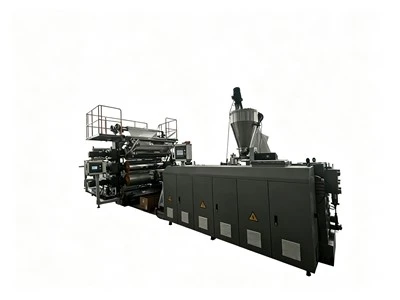
Hey there! As a supplier of Pellet Extrusion Lines, I'm super stoked to break down the main components of these awesome machines. Whether you're into making plastic pellets for various industries or just curious about how it all works, this blog is for you. So, let's dive right in!
1. Feeding System
The feeding system is like the starting point of the whole process. It's responsible for getting the raw materials into the extrusion line. There are different types of feeders, but the most common ones are volumetric and gravimetric feeders.
Volumetric feeders are pretty simple. They measure the volume of the raw material and feed it into the extruder at a set rate. They're great for basic applications where the accuracy of the feed rate isn't super critical.
On the other hand, gravimetric feeders are more precise. They measure the weight of the raw material, which allows for a more accurate and consistent feed rate. This is especially important when you're working with expensive or high - quality materials.
The feeding system also includes hoppers. These are containers that hold the raw materials. They come in different sizes and shapes, depending on the amount of material you need to store and feed.
2. Extruder
The extruder is the heart of the Pellet Extrusion Line. It's where the magic happens! The main job of the extruder is to melt and mix the raw materials.
It consists of a barrel and a screw. The raw materials are fed into the barrel, and the screw rotates, pushing the materials forward. As the materials move through the barrel, they're heated by heaters around the barrel. The heat melts the materials, and the screw helps to mix them thoroughly.
There are different types of extruders, such as single - screw and twin - screw extruders. Single - screw extruders are simpler and cheaper, but they're not as efficient at mixing and melting the materials. Twin - screw extruders, on the other hand, are more complex and expensive, but they offer better mixing and higher throughput.
If you're interested in a specific type of extrusion line, like a PVC Pelletizing Line, the extruder needs to be designed to handle PVC materials properly.
3. Die
The die is located at the end of the extruder. It's a tool that gives the extruded material its shape. In the case of a Pellet Extrusion Line, the die usually has small holes. As the melted material comes out of the die, it forms long strands.
The size and shape of the holes in the die determine the size and shape of the pellets. For example, if you want round pellets, the holes in the die will be circular. The die needs to be made of high - quality materials to withstand the high pressure and temperature of the extrusion process.
4. Cooling System
Once the strands come out of the die, they're still hot and soft. The cooling system is used to cool the strands down so that they can be cut into pellets.
There are different types of cooling systems, such as water baths and air coolers. Water baths are the most common. The strands are passed through a tank filled with water, which rapidly cools them down. Air coolers, on the other hand, use air to cool the strands. They're less efficient than water baths, but they're more suitable for some applications where water isn't a good option.
5. Pelletizer
The pelletizer is the machine that cuts the cooled strands into pellets. There are two main types of pelletizers: strand pelletizers and underwater pelletizers.
Strand pelletizers are the most common. They use rotating blades to cut the strands into pellets. They're relatively simple and inexpensive, but they can sometimes produce unevenly shaped pellets.
Underwater pelletizers are more advanced. They cut the strands into pellets while they're still in the water. This results in more uniform and round pellets. However, they're more complex and expensive to operate.
6. Conveying System
After the pellets are made, they need to be transported to the next stage, such as a storage silo or a packaging machine. The conveying system is responsible for this.
There are different types of conveying systems, such as belt conveyors, screw conveyors, and pneumatic conveyors. Belt conveyors are the most common. They use a belt to move the pellets from one place to another. Screw conveyors use a rotating screw to push the pellets forward. Pneumatic conveyors use air to transport the pellets through a pipeline.
7. Screening and Classification System
Not all pellets are perfect. Some may be too big, too small, or have other defects. The screening and classification system is used to separate the good pellets from the bad ones.
It usually consists of screens with different mesh sizes. The pellets are passed through the screens, and the ones that are the right size fall through, while the ones that are too big or too small are removed.


8. Control System
The control system is like the brain of the Pellet Extrusion Line. It's used to monitor and control all the components of the line.
It includes sensors that measure things like temperature, pressure, and speed. The control system uses this information to adjust the operation of the line to ensure that the pellets are made to the right specifications.
Modern control systems are often computer - based, which allows for more precise control and easier operation.
9. Auxiliary Equipment
There's also some auxiliary equipment that can be used with the Pellet Extrusion Line. For example, a dryer can be used to remove any moisture from the raw materials before they're fed into the extruder. A mixer can be used to mix different types of raw materials together.
If you're interested in a Color Masterbatch Extrusion Line, you'll need additional equipment to handle the colorants and ensure that they're evenly mixed with the base resin.
Similarly, a PE Pelletizing Line may require specific equipment to handle polyethylene materials.
Why Choose Our Pellet Extrusion Lines?
Our Pellet Extrusion Lines are designed with high - quality components and the latest technology. We offer a wide range of options to meet your specific needs. Whether you're a small - scale producer or a large - scale industrial manufacturer, we've got you covered.
Our lines are easy to operate and maintain, which means you can focus on producing high - quality pellets without any hassle. We also provide excellent after - sales service to ensure that your line is always running smoothly.
If you're in the market for a Pellet Extrusion Line, we'd love to have a chat with you. We can discuss your requirements, provide you with a quote, and answer any questions you may have. Just reach out to us, and let's start the conversation!