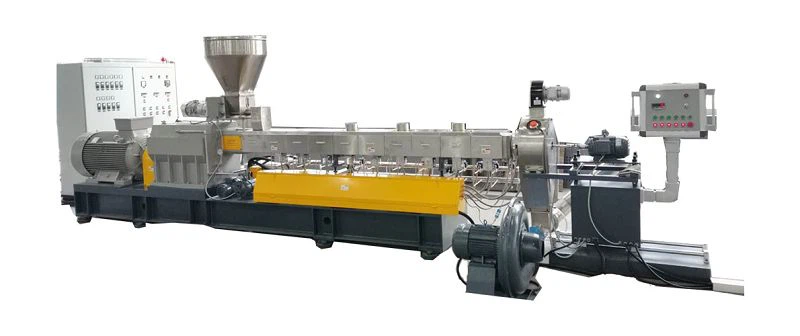
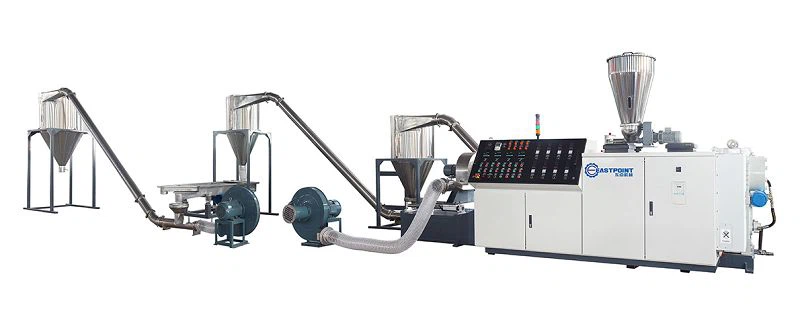
The power consumption of a single screw extruder is a critical factor that both manufacturers and operators need to understand thoroughly. As a single screw extruder supplier, we are committed to providing our customers with not only high - quality equipment but also in - depth knowledge about its performance and cost - related aspects.
1. Understanding the Basics of a Single Screw Extruder
A single screw extruder is a widely used machine in the plastics and food processing industries. It consists of a single screw rotating within a barrel. The main function of the extruder is to convey, melt, and pump the raw materials, usually in the form of pellets or powder, through a die to create a continuous profile. The screw design, barrel diameter, and length of the extruder are some of the key factors that influence its performance and power consumption.
2. Factors Affecting Power Consumption
2.1 Screw Design
The design of the single screw plays a crucial role in determining power consumption. Screws can have different geometries, such as the pitch, flight depth, and compression ratio. A screw with a high compression ratio requires more power to drive the material forward as it compresses the material more intensively. For example, a screw with a compression ratio of 3:1 may consume more power than a screw with a compression ratio of 2:1, because it has to work harder to reduce the volume of the material.
2.2 Material Properties
The type and properties of the material being processed also have a significant impact on power consumption. Materials with high viscosity, such as some engineering plastics, require more energy to melt and flow. For instance, processing polycarbonate (PC) will generally consume more power compared to polyethylene (PE) due to its higher melt viscosity. Additionally, the moisture content in the raw material can affect the power consumption. If the material has a high moisture content, more energy will be needed to evaporate the moisture during the extrusion process.
2.3 Extrusion Speed
The speed at which the screw rotates, known as the extrusion speed, is directly related to power consumption. Higher extrusion speeds typically require more power. When the screw rotates faster, it has to move a larger amount of material in a shorter time, which increases the load on the motor. However, increasing the extrusion speed also increases the production rate. So, there is a trade - off between power consumption and production efficiency that manufacturers need to consider.
2.4 Barrel Temperature
Maintaining the appropriate barrel temperature is essential for the extrusion process. If the barrel temperature is too low, the material will not melt properly, and the screw will have to work harder to move the solid or semi - solid material, resulting in higher power consumption. On the other hand, if the temperature is too high, it may not only waste energy but also cause degradation of the material. Therefore, accurate temperature control is necessary to optimize power usage.
3. Calculating Power Consumption
The power consumption of a single screw extruder can be estimated using the following general formula:
[P = \frac{Q\times \Delta P}{\eta\times\rho}]
where (P) is the power consumption (in kilowatts), (Q) is the volumetric flow rate of the material (in (m^{3}/s)), (\Delta P) is the pressure difference across the extruder (in Pa), (\eta) is the efficiency of the extruder, and (\rho) is the density of the material (in (kg/m^{3})).


However, in practical applications, it is often difficult to accurately measure all these parameters. Therefore, many manufacturers rely on empirical data and experimental results to estimate power consumption. For example, some single screw extruders may consume around 0.1 - 0.3 kWh per kilogram of processed material, depending on the factors mentioned above.
4. Comparison with Other Types of Extruders
When evaluating the power consumption of a single screw extruder, it is useful to compare it with other types of extruders.
4.1 Conical Twin Screw Extruder
Conical twin screw extruders generally have a higher power consumption than single screw extruders. This is because they have two intermeshing screws that require more energy to drive. However, they also offer higher mixing efficiency and better dispersion of additives, which may justify the higher power cost in some applications.
4.2 Two Screw Extruder
Two - screw extruders, also known as co - rotating or counter - rotating twin - screw extruders, can process materials more efficiently in many cases. They can have a wider range of power consumption depending on their design and application. In some high - end applications where precise control and high throughput are required, they may consume more power than single screw extruders.
4.3 Pipe Extruder
Pipe extruders are specialized extruders for producing pipes. They may have different power consumption characteristics compared to general - purpose single screw extruders. The power consumption of a pipe extruder depends on factors such as the pipe diameter, wall thickness, and extrusion speed. In some cases, larger - diameter pipes may require more power to extrude.
4.4 Parallel Twin Screw Extruder
Parallel twin screw extruders are known for their high - speed and high - throughput capabilities. They usually consume more power than single screw extruders due to the additional screw and the higher processing capacity. However, they are often used in applications where large - scale production is needed, and the increased power cost can be offset by the higher production rate.
4.5 CPVC Pipe Machine
CPVC pipe machines are designed specifically for processing CPVC materials to produce pipes. CPVC has different material properties compared to other plastics, and these machines may require specific power consumption levels. Generally, due to the higher heat resistance and viscosity of CPVC, the power consumption of CPVC pipe machines may be relatively high compared to extruders for processing other common plastics.
5. Strategies to Reduce Power Consumption
As a single screw extruder supplier, we understand the importance of reducing power consumption for our customers. Here are some strategies that can be adopted:
5.1 Optimize Screw Design
Working with experienced engineers to design a screw that is tailored to the specific material and application can help reduce power consumption. A well - designed screw can ensure efficient material conveyance and melting with less energy input.
5.2 Improve Material Preparation
Proper material drying and pre - heating can reduce the energy required for melting during the extrusion process. Ensuring that the material has the right moisture content and temperature before entering the extruder can lead to significant power savings.
5.3 Use Energy - Efficient Motors and Drives
Installing high - efficiency motors and variable - frequency drives can help adjust the power input according to the actual processing requirements. These technologies can reduce energy waste during periods of low - load operation.
5.4 Precise Temperature Control
Using advanced temperature control systems can maintain the optimal barrel temperature, preventing over - heating or under - heating. This not only improves the quality of the extruded product but also reduces power consumption.
6. Conclusion and Call to Action
Understanding the power consumption of a single screw extruder is essential for manufacturers to optimize their production costs and improve energy efficiency. As a professional single screw extruder supplier, we have in - depth knowledge and rich experience in this field. We can provide you with high - quality single screw extruders and offer customized solutions to meet your specific needs.
If you are interested in our single screw extruders or want to discuss more about power consumption and extrusion technology, please feel free to contact us for procurement and negotiation. We are looking forward to working with you to achieve greater success in your production.